
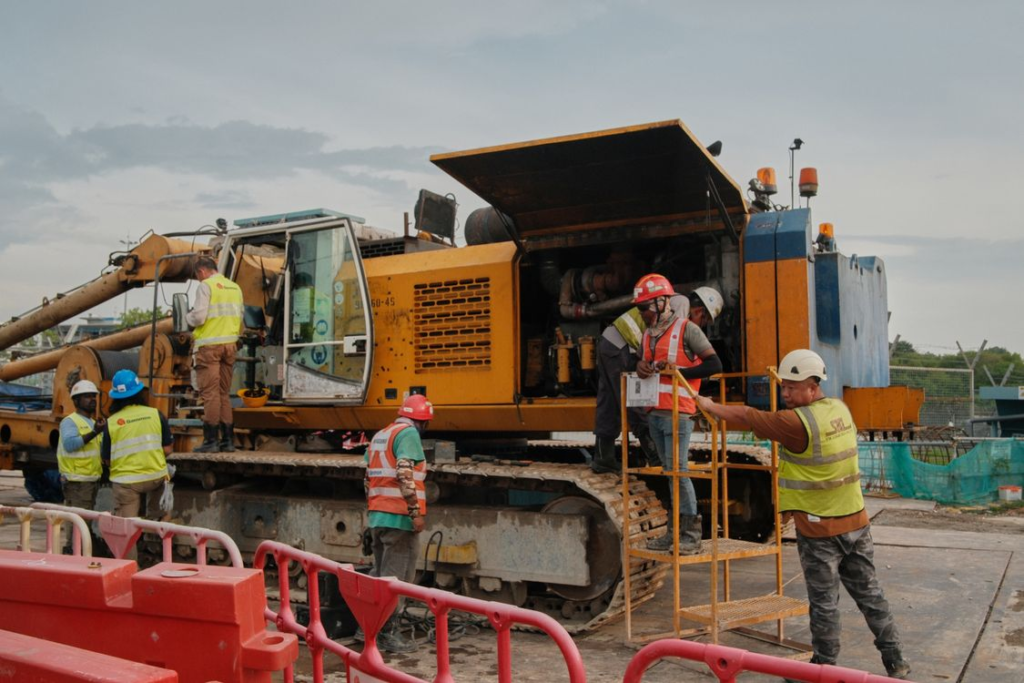
Property developers face a unique and costly challenge: their most valuable assets are left exposed in an open, evolving environment for months or even years at a time. Equipment worth hundreds of thousands of dollars sits unattended overnight. Raw materials stack up in plain sight. And the rotating workforce of contractors and subcontractors makes it nearly impossible to track who belongs on-site and who doesn’t. Effective construction site security isn’t a luxury for large-scale developers — it’s a fundamental project management requirement. At Cyber Guard Protection, we work with property developers across the Inland Empire to design and deploy security programs that prevent theft, deter vandalism, and keep projects on schedule and on budget. This guide covers the best practices every developer should have in place before breaking ground.
Conduct a Pre-Construction Security Risk Assessment
Every effective security program starts with a clear-eyed look at the specific risks your site faces. Before the first shovel hits the ground, developers should evaluate:
- The neighborhood’s existing crime rate and history of construction-related theft
- The site’s perimeter — how accessible is it on foot, by vehicle, after dark?
- The value and replaceability of materials and equipment that will be on-site
- The number of access points and how they will be controlled during active and inactive hours
- Fire risks related to hot work, fuel storage, or temporary electrical installations
At Cyber Guard Protection, our team conducts site assessments for developers seeking construction site security in San Bernardino, CA, and throughout the Inland Empire, evaluating all of these factors before recommending a security deployment model. A risk assessment isn’t an administrative exercise; it’s what separates a targeted security strategy from one that wastes budget on the wrong coverage.
Establish Strong Perimeter Control from Day One
The perimeter is your first and most important line of defense. A site that can be accessed by anyone, at any time, from any direction, is not a secured site — it’s an open invitation. Best practice perimeter control includes:
High-Visibility Fencing: Chain-link or temporary construction fencing clearly marks the site boundary and discourages casual trespassing. Anti-climb features and locked gates at all entry points further reduce unauthorized access.
Controlled Entry and Exit: A single, staffed access point with a sign-in/sign-out protocol creates accountability for everyone on-site. Contractors, subcontractors, delivery drivers, and inspectors should all be logged.
Posted Security Signage: Visible signage alerting the public to 24-hour security monitoring, surveillance cameras, and trespassing consequences acts as a deterrent before any criminal even approaches the fence line.
Our team at Cyber Guard Protection regularly deploys personnel for construction site security in Moreno Valley, CA, who are specifically trained to manage access control in active multi-contractor environments — a more complex task than it might appear.
Deploy Professional Security Guards — Not Just Cameras
Surveillance technology is a valuable tool, but cameras don’t stop crime — they document it. A motivated thief will steal from a camera-equipped site. A site with a visible, trained security officer on patrol is a fundamentally different proposition.
For construction sites, professional guard deployment should consider:
After-Hours Coverage: The vast majority of construction site theft occurs overnight and on weekends, when no workers are present. Overnight guard coverage — whether static or mobile patrol — is where the return on investment is highest.
Roving Patrol vs. Fixed Post: Large sites benefit most from mobile patrol security, where officers cover the full perimeter and interior on a rotating schedule. Smaller sites with a single high-value asset concentration may benefit from a fixed post.
Uniformed Presence During Active Hours: Even during daytime operations, a uniformed guard managing the entry point and monitoring contractor access deters opportunistic theft by workers and visitors alike.
The National Equipment Register reports that construction equipment theft costs the U.S. industry over $1 billion annually, with low recovery rates. Read more at National Equipment Register. Professional guard deployment is the single most effective intervention for reducing that risk.
Integrate Fire Watch Into Your Security Program
Construction sites are among the highest-risk environments for fire. Hot work — welding, cutting, grinding — creates ignition hazards. Temporary fuel storage, open electrical systems, and combustible materials compound the risk further. When fire suppression systems are not yet installed or are temporarily offline, California law and NFPA standards require fire watch coverage.
At Cyber Guard Protection, our fire watch security services integrate seamlessly with our construction site security programs. Rather than managing a separate fire watch vendor, developers can deploy a single security team that handles both perimeter security and fire watch compliance — simplifying logistics and reducing cost.
OSHA’s construction safety standards detail fire prevention requirements for active job sites at OSHA Construction Safety – Fire Prevention. Non-compliance can result in project shutdowns, fines, and liability exposure that far exceeds the cost of proper coverage.
Implement Equipment and Materials Tracking
Security guards protect your assets in real time — but asset tracking protocols protect your ability to recover losses and file insurance claims when incidents do occur. Best practices include:
- Serial number logging for all major equipment on-site
- Photographic inventory of high-value materials at delivery
- Daily equipment check-in and check-out logs managed by your security team
- Secure, locked storage for portable tools and small equipment
- GPS tracking devices installed on large machinery and vehicles
Establish Clear Incident Reporting and Escalation Protocols
Even with the best preventative measures in place, incidents will occasionally occur. How quickly and professionally your team responds determines the downstream impact — on your insurance claim, your project timeline, and your legal exposure.
Every construction site security program should include:
- A written incident reporting format that guards complete immediately following any event
- Clear escalation procedures — when to call the property developer, when to call police, when to call emergency services
- Documented patrol logs that establish a timeline of guard activity before and after any incident
- Regular security briefings for guard personnel as site conditions evolve
Effective construction site security requires more than a fence and a camera — it demands a professional, layered strategy that’s built around the specific risks of your project and location. Whether you need construction site security in San Bernardino, CA, in Riverside, CA, or in Ontario, CA, the fundamentals remain the same: strong perimeter control, professional guard deployment, fire watch compliance, asset tracking, and clear incident protocols. Cyber Guard Protection delivers all of it under one contract, with experienced personnel who understand the construction environment and the developer’s need to keep projects on schedule.
Don’t leave your development project exposed. Contact Cyber Guard Protection today to schedule a site assessment and get a customized security plan built around your project timeline, location, and risk profile.